
Comparison · checked on
Heptabase alternative: what Creatos does differently, and when to stay
Heptabase is a subscription knowledge app built on whiteboards and cards, with sync across your devices and an AI agent that runs on monthly credits. People who look for an alternative usually name three things: there is no free plan beyond a 7-day trial, GPT and Claude need the Premium plan ($17.99 a month billed yearly), and notes sync to Heptabase's cloud by default. Creatos, the app we make, is a different kind of tool: a desktop canvas you buy once for $69, where PDFs, YouTube videos and web pages sit next to several AI models that run on your own keys or on your own computer. It answers some of those complaints and not others, so this page says which.
Short answer
- Pick Creatos if you want to pay once, use any model with your own API key or run models locally through Ollama, and put several models' answers to the same source side by side.
- Stay with Heptabase if you need your notes on a phone, the web or Linux, sync between devices, sharing with other people, a daily journal or tag databases, or MCP access from Claude and ChatGPT. Creatos has none of those.
- Neither is free. Heptabase has a 7-day trial. Creatos has no trial and needs a license to open.
Heptabase and Creatos side by side
| Heptabase | Creatos | |
|---|---|---|
| Price | From $11.99 a month, or $107.88 a year | $69 once, with updates included |
| Try before you pay | 7-day trial on any plan | No trial |
| AI included | 100 to 8,100 credits a month, by plan | None: you pay your AI provider, or nothing for local models |
| Models | Gemini on Pro; GPT, Claude and Gemini on Premium and up | Any model from 13 cloud providers or an OpenAI-compatible endpoint, plus Ollama |
| Several models on one source | No side-by-side view found | Several AI nodes on the same source, answers side by side |
| Where notes live | Local database plus cloud sync, on by default | On your computer |
| Platforms | macOS, Windows, Linux, web, iOS, Android | macOS 12+ on Apple Silicon, Windows 10+ (64-bit) |
| Sharing | Real-time collaboration on shared whiteboards and cards | None |
| Notes features | Cards, journal, tag databases, PDF highlights, web clipper | Canvas of sources, AI nodes, notes and outputs |
| MCP | Official server, plus ChatGPT and Claude plugins | None today |
Heptabase facts come from its own pricing, help-center, changelog and roadmap pages, read on 11 October 2026 and linked below. Creatos facts are for the current release, 0.1.47.
What you pay
| Plan | Monthly | Yearly | AI credits a month |
|---|---|---|---|
| Heptabase Pro | $11.99 | $107.88 | 100 |
| Heptabase Premium | $23.99 | $215.88 | 1,800 |
| Heptabase Premium+ | $71.99 | $647.88 | 8,100 |
| Creatos | n/a | $69 once | None, bring your own |
Heptabase's plans page gives the monthly and yearly prices; its pricing page shows the yearly ones as $8.99, $17.99 and $53.99 a month. Unused credits don't roll over. Past the allowance you can upgrade, turn on pay-as-you-go billing with a monthly cap, use your own API key, or sign in with ChatGPT through Codex. The free plan is only for people a paid user invites to collaborate.
Over two years, Heptabase Pro on yearly billing comes to $215.76 and Premium to $431.76. Creatos is $69 once, but the AI isn't included: cloud models are billed by the provider whose key you add. That can be very little. In our test on a 73K-token jobs report, one question cost $0.0074 with Claude Haiku 5.5 and $0.147 with Claude Sonnet 5.5 at API prices. Local models through Ollama cost nothing per question.
Refunds are similar on both. Heptabase's terms say fees paid are non-refundable, and its help center reviews requests case by case. Creatos purchases are generally non-refundable except where the law requires it. The real difference is that Heptabase lets you try it for a week first and Creatos doesn't.
AI: credits and plans, or your own keys
In Heptabase, the plan decides the models. Pro gets "Gemini models only"; Premium and Premium+ add GPT and Claude. Heptabase adds new models itself, and its changelog shows GPT-6 Sol, GPT-6 Luna and Claude Opus 5.5 arriving on 23 September 2026. You can also connect your own API key, and those requests don't use credits, though the AI Tutor and voice notes always do.
In Creatos there are no credits. You add keys for the providers you use: Anthropic, OpenAI, Google, DeepSeek, Mistral, Cohere, Groq, Perplexity, Together, Fireworks, MiniMax, Kimi and GLM, any OpenAI-compatible endpoint, or Ollama for models on your own computer. Each provider has a built-in model list, and you can add any other model ID it offers yourself.
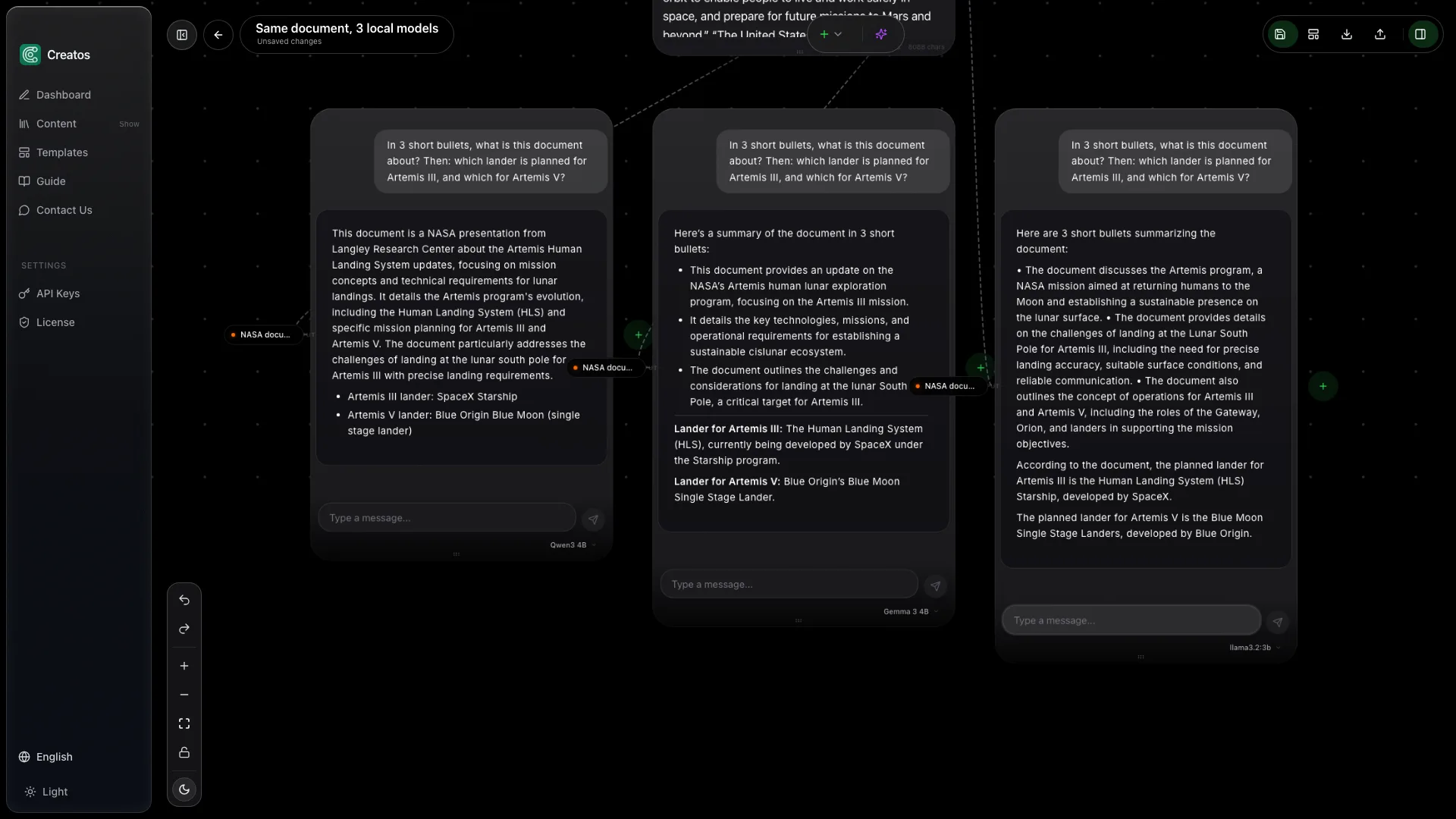
The bigger difference is how you use them. A Creatos canvas connects one source, such as a PDF or a YouTube video, to several AI nodes, so you ask the same question of three models and read the answers next to each other. We found no side-by-side model comparison in Heptabase's help center or changelog: you pick one model per chat.
Where your notes live
Heptabase's data page says the desktop app "keeps a local database for offline use", and cloud sync is on by default. Synced data is stored on Heptabase's cloud on AWS in us-west-1, encrypted in transit and at rest but not end to end, because cloud search and AI need to read it. Local auto-backups were replaced by cloud backups in December 2025, and those don't include attachments. You need an account, and a full export gives you Markdown plus a JSON file, without whiteboard layouts.
Creatos is a desktop app with local-first storage: your files and canvases stay on your computer, and there is no sync. You activate it with your purchase email and license key. When you use a cloud model, the text it needs goes to that provider under your key. With Ollama, nothing leaves the machine.
What you give up by switching
Heptabase is a full note-taking system and Creatos isn't. Moving would cost you:
- Your phone and other computers. Heptabase runs on macOS, Windows, Linux, the web, iOS and Android. Creatos runs on macOS 12 or later on Apple Silicon and 64-bit Windows 10 or later, with no sync between them.
- Sharing. Heptabase shares whiteboards and cards with permission levels, and invitees join free. Creatos has no sharing.
- Notes structure. Heptabase has cards with backlinks, a daily journal, tag databases with views, PDF highlights, a web clipper and Zotero and Readwise imports. A Creatos canvas holds sources, AI nodes, notes and outputs, and that's all.
- Built-in AI study tools. Heptabase's AI Tutor builds lessons from your material, and its agent can search your whole knowledge base. Creatos AI nodes read the sources you connect to them.
MCP and outside AI apps
Heptabase has an official MCP server at https://api.heptabase.com/mcp, signed in with OAuth. Its tool reference lists tools to list, search and read cards, whiteboards, journals and parsed PDFs, and to create notes, edit text and place cards on a whiteboard. It can't upload files or create image cards. There are setup guides for ChatGPT, Claude Code, Cursor and Antigravity, a ChatGPT and Codex plugin since 23 September 2026, and a Claude plugin in the changelog on 9 October 2026.
Creatos has no MCP server today, so Claude or ChatGPT can't reach your canvases. If you want your notes inside the Claude or ChatGPT apps, Heptabase is the better fit.
If neither fits
- Obsidian is free with "no sign-up required", according to its pricing page, and keeps notes as Markdown files on your disk. Its Canvas core plugin lays out notes, PDFs, images and web pages on an infinite board. Sync is $4 a month on yearly billing.
- Heptabase Pro with your own key is worth a look if the credits were your only problem: your key's requests don't use credits, and you keep sync and mobile.
FAQ
Does Heptabase have a free plan?
Not one you can sign up for. Heptabase gives a 7-day trial on any plan. Its only free plan is for people a paid user invites to collaborate, and its help center says there is no other way to register for it.
Does Heptabase have a lifetime or one-time license?
No. Pro is $11.99 a month or $107.88 a year, Premium $23.99 or $215.88, and Premium+ $71.99 or $647.88. The old early-bird price is a subscription rate some users keep, not a lifetime license.
Can I use my own API key in Heptabase?
Yes. Heptabase’s help page lists OpenAI, Anthropic, Gemini and OpenRouter keys plus OpenAI-compatible providers, and requests made with your key don’t use credits. Its plans page is narrower and says OpenAI or Anthropic keys for the AI Agent only. The AI Tutor and voice notes always use Heptabase credits.
Where does Heptabase store my notes?
The desktop app keeps a local database for offline use, and cloud sync is on by default. Synced data is stored on Heptabase’s cloud on AWS in us-west-1, encrypted in transit and at rest but not end to end. Local auto-backups were replaced by cloud backups in December 2025.
Does Heptabase have an MCP server?
Yes. The official server is at https://api.heptabase.com/mcp and you sign in with OAuth. It can list, search and read cards, whiteboards, journals and parsed PDFs, and create and edit notes. Heptabase has setup guides for ChatGPT, Claude Code, Cursor and Antigravity.
Does Creatos have a free trial?
No. Creatos costs $69 once, the app needs a license to open, and purchases are generally non-refundable except where the law requires it. If you want to try before you pay, Heptabase’s 7-day trial or Obsidian’s free app are the lower-risk starts.
Can Creatos run AI models without sending my files to the cloud?
Yes, with local models through Ollama. On a 16 GB M4 Mac mini we ran Qwen 3, Gemma 3 and Llama 3.2 side by side on a 32-page NASA PDF in Creatos, all on the machine. Speed and the models you can run depend on your hardware.
Who wrote this
We make Creatos, so read this with that in mind. Every Heptabase fact here comes from Heptabase's own pricing, help center, changelog and roadmap, read on 11 October 2026, and we've tried to say where it is the better choice. See our model tests for what side-by-side answers look like.